Outliers always had it difficult.
They never fit the norm. They struggled to meet the expectations of society. We often hear how much society cares about the unusual person, the gifted child, the misfit, the original mind.
But I prefer to watch what society does, not what it says.
Over the past year, I conducted a personal experiment.
I left less-polished fragments in public windows. Raw thoughts. Unfinished maps. Signals sent into the fog.
I wanted to see whether my writing could pierce through the veil and attract aligned outliers.
People like me are rare.
But in a world of more than eight billion people, I know we are not alone.
There must still be millions of us.
Scattered, perhaps.
Silent, perhaps.
Each carrying a candle behind closed shutters.
One could build an army from us.
So why do I keep writing for crickets?
Broken roads
Before the experiment, I had assumptions.
Now I have data.
The roads are simply not built to carry voices like mine.
I know you are out there somewhere, reading, watching, thinking, recognizing fragments. But it seems almost anomalous when the mysterious algorithm pushes my work toward you, or toward people like you.
Social media rewards short sentences.
It rewards polarizing arguments.
It rewards fighting.
It rewards people who can repeat a narrow set of claims until the machine finally understands what shelf to put them on.
It does not care whether the people arguing have something to say in the first place.
Depth is often punished.
Empty-headed certainty is rewarded.
As if the whole pyramid were reversed.
The false prophets get the spotlight because they understand the stage.
This is not new.
We can look even at Jesus Christ.
I am not claiming to be him. That would be absurd.
But the pattern is old enough to recognize.
A strange man arrives with something unusual. Some outliers recognize him and gather around him. But the larger society cannot easily put him in a box. So first it doubts him. Then it mocks him. Then it punishes him. In the end, it is often easier to remove the anomaly than to understand it.
The system prefers recognizable forms.
Hold your line, but not too much.
Make bold claims, but inside safe boundaries.
Repeat a few narrow topics over and over.
Become legible.
Become useful.
Become predictable.
Do that, and the system may reward you.
But present yourself as a generalist who sees across domains, behind the veil, through institutions, incentives, masks, rituals, and stories, and your mind becomes difficult to distribute.
The roads were built for merchants, soldiers, preachers, and entertainers.
Not for men carrying maps of places no one has named yet.
Being ground from both sides
I am torn.
I am not a divine being from another world.
I also need a place to stay, something to eat, and a way to live inside a society that was not built for me.
So what options do I have?
I could diminish myself to fit a container.
I could pretend to be a drone.
I could reshape myself enough to fit a box.
I could get work.
I am sure my curiosity would carry me for a while. It usually does. New domains still interest me. New systems still give me something to study.
But then the old pattern would return.
The frustration would come back.
Because deep inside, I would know that most of my talents were being wasted.
I refused that life years ago.
My other option is to let the world discover me and realize there is no single box to put me in.
But how can I do that?
By entering another box.
Social media.
Institutions.
Existing systems.
The old roads.
I tried that, and the road did not bend.
So should I make myself smaller?
Should I become more predictable?
Should I say exactly what the algorithms reward?
And if I do, how do I avoid losing myself in the process?
There is a cost to optimization.
If I flatten the message enough to be visible, the right outlier may pass by and never realize there was depth behind it.
That is the trap.
One stone asks me to become a tool.
The other asks me to become a spectacle.
One asks for labor.
The other asks for performance.
One asks me to disappear into a function.
The other asks me to shine as a simplified signal.
Whatever I do, I bump into systems built for almost anyone but me.
That is why I feel ground between two stones.
What would I do if money were solved?
I am not Jesus.
I admire him, but I am no martyr.
If I had enough money for a decent life, I would likely stop caring about the game.
No misaligned work.
No misaligned public performance.
No constant need to explain myself to systems that do not know what they are looking at.
Yes, that might mean nobody would discover me.
So what?
Good Will Hunting taught me something important.
We owe nothing to society.
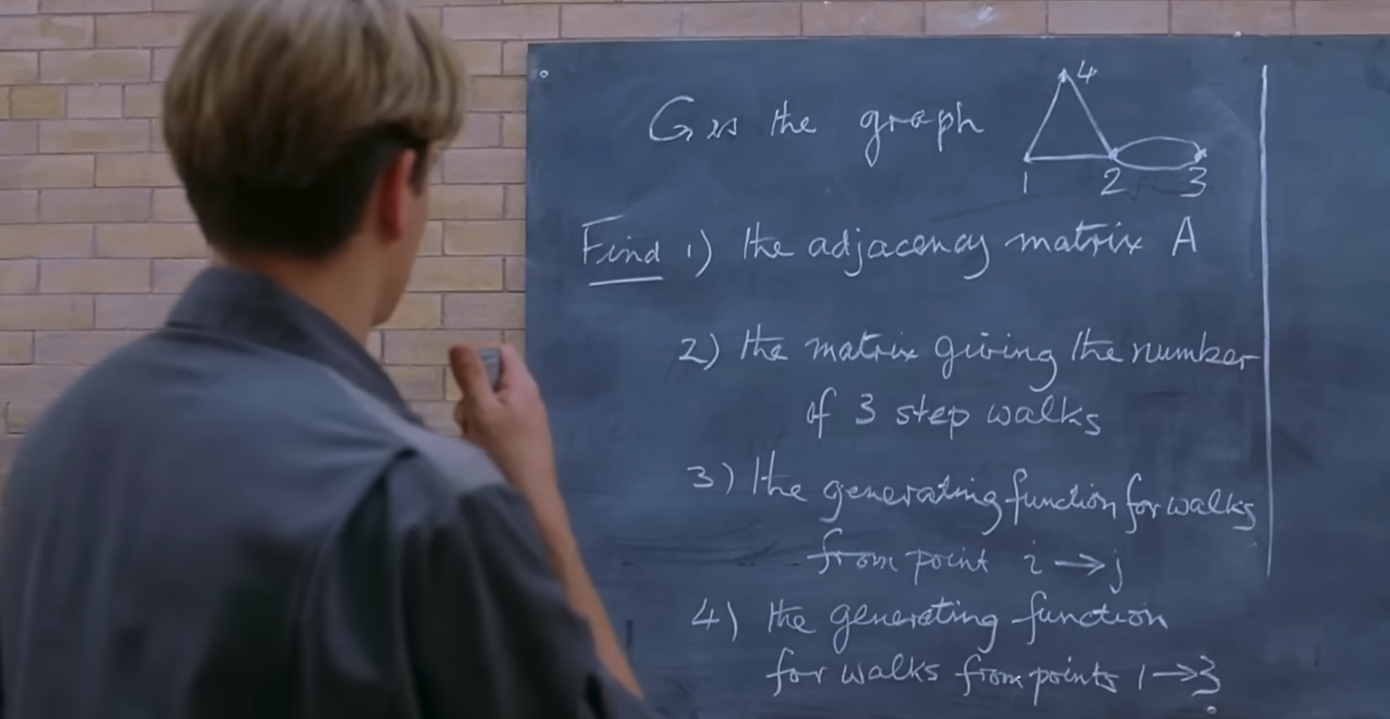
Even a genius who might have the power to cure cancer has the right to leave, love someone, disappear, and live his life.
That thought stayed with me.
I dream of finding more outliers.
I dream of a realm where people like us can work together, energized, alive, and finally without artificial limits.
It is a beautiful dream.
But the dream has a cost.
I might do everything right and the world might still refuse my proposal.
A sanctuary still needs walls.
A realm still needs food.
A workshop still needs tools.
Even if I found thousands of outliers, we would still need to survive inside a world not built for us.
If I had enough money, I might leave the dream on paper.
Not because the dream is bad.
But because I value my life too much to sacrifice it to something that may never materialize.
Leonardo da Vinci would understand
Today we see Leonardo da Vinci as a genius.
I see something else too.
I see a man who still had bills to pay.
A contractor for hire.
A man who needed patrons.
A man who entered courts, accepted commissions, designed things for others, and negotiated with the world because even Leonardo had to live somewhere.
Those contracts were not the whole man.
They were the interface.
Where was his true passion?
In my opinion, it was in his notebooks.
His studies.
His sketches.
His investigations.
His machines.
His anatomy.
His water.
His birds.
His canon.
If Leonardo lived today, would he have the patience to post on social media every day?
Would he argue in comment threads to grow his following?
Would he optimize thumbnails and hooks?
Would he repeat the same narrow claim until the algorithm learned his shape?
Or would he rather be left alone to sketch flying machines, study anatomy, investigate rivers, design mechanisms, and follow whatever captured his mind?
I think I know the answer.
Because I know what I would choose.
I continue building anyway
This is the part most romanticized historical movies skip.
Every success is usually preceded by a long, frustrating period when the work appears to happen in complete silence.
I even suspect there is a relationship:
the more unusual the thing is, the longer the silence lasts.
When someone builds something that already has a category, the world has language for it.
There are examples.
There are markets.
There are stories.
There are familiar promises.
But when someone builds something nobody has quite attempted before, people often see him as a madman until reality catches up.
Sometimes it never does.
That is the terrible part.
Some strange journeys become legends.
Others become dead ends.
From the inside, they can feel almost identical.
Is my journey one of those dead ends?
I wish I knew.
If I knew it was, I would save the time.
If I knew it was not, I would endure the silence more easily.
But I do not know.
Nobody does.
So I keep building.
We will see reality unveil itself.
In a way, the uncertainty is both a blessing and a curse.
We have to dream sometimes.
Especially when we are down.
I see the realm every day in my head.
Alive.
Not as a slogan.
Not as a brand.
Not as a content strategy.
As a place.
Maybe one day we will shape reality around us, together.